Showing posts with label Jeffrey Renaud. Show all posts

Sunday, May 20, 2012

Please MIND Cow Boy and Bat Man

 Here's an update for page 78 - bringing back the villains from earlier (much earlier by now) in Part One. Max Von Sydow and Jason Miller from the Exorcist were my models for the Sadducees - though if you were to look at them, of course, you'd probably not "see it." Dustin isn't based on anyone in particular.

(You'd probably be surprised to see who the other characters are based off - ask away, I'll tell you).
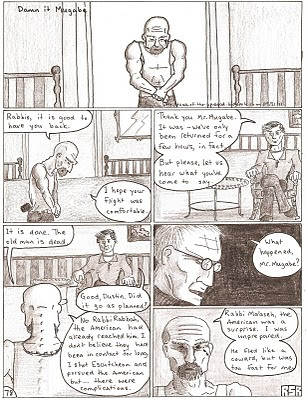
Page 78
The directors of the mysterious murderer chasing Evelyn, Casey and Howard is revealed to be Dustin Mugabe by his directors in Damnit Mugabe. Hope you like it!
See more by following the links:
Graphic novel news
Described as "Deadwood for kids," Cow Boy is cute ... but read how this story has a hard look at the price people say for choosing to be moral, and melancholy. Also, read how Lost co-creator and showrunner Damon Lindelof found his way to being involved with Jeff Lemire and a new Batman digital novel. Lastly, read about the thick and intense data being crammed into each issue of MIND MGMT - so much the author says reading it all in one sitting "might be hazardous to your mental health."

'Cow Boy' By Nate Cosby And Chris Eliopoulos: More Than Cute [Review] 
Matt D. Wilson
Comics Alliance


'Cow Boy'


Speaking with Chris Sims and me on the War Rocket Ajax podcast a few weeks ago, Cosby described Cow Boy as "Deadwood for kids." Thematically, that's a pretty good comparison. Both stories take a hard look at the price people pay for choosing to be moral, and have a pretty strong underlying sense of melancholy as a result.
Click to read more.

EXCLUSIVE: Damon Lindelof On His And Jeff Lemire's "Batman" Digital Comic 
Jeffrey Renaud
Comic Book Resources
Jeff Lemire's Batman
What happened was that I basically became obsessed with Jeff [Lemire]. [Laughs] I read "Sweet Tooth" and was like, "Holy shit. Who is this guy?" I googled him and found out about "Essex County," so I ran out and grabbed the collected edition and read it cover to cover. Then I tweeted about him and about how awesome "Sweet Tooth" was. And then, he tweeted back at me, we exchanged email addresses and just started talking to each other.
Click to read more.

Matt Kindt Shares the Secrets of "3 Story" & "Mind MGMT" 
Shaun Manning
Comic Book Resources


Mind MGMT


The series ... deals with questions of how we perceive the world and how those perceptions are manipulated, and Kindt said this will play out through the series' episodic format.

"I think a lot of the inspiration for how I'm telling the story this time around came from the actual format that the story is in," Kindt said. "At this point it seems like there's no one making monthly comics anymore. The monthly comics come out but they're mostly written for trades. So I'm actually trying to make a 24-page comic that is a satisfying read all on its own. To me, that means making something that takes a while to get through. And something that will take multiple readings to get everything out of it.

[....] So the inside covers/back covers have super dense stories and there are back cover ads with secret messages and that actually work as a bigger puzzle (when you put the first six issues together). And I'm writing a MIND MGMT field guide that I'm threading into the borders of each page -- guide excerpts that give you insight into the MIND MGMT organization but also serve double duty by commenting on the actual page you're reading. I'm hoping it's dense. I did a similar thing with 'Super Spy.' I was writing that book as a weekly 8-page comic. Each week had to stand on its own. And then when I put it together in the eventual graphic novel it became this crazy dense puzzle-box of a book. 'Mind MGMT' is following a similar path, I think. I think it will be way healthier to read this book in monthly installments rather than waiting for the collection -- that might be hazardous to your mental health."
Click to read more.

Sunday, March 27, 2011

Milking chickens, man of bronze and writing tips

Here's the first page of the next scene, All in. I forewarned that you'll see left hands where they don't belong - and on this page the terror returns.

Disregard the man with the two left hands - he ate the wrong thing for breakfast and now he's ... got awful left hands. For the record, if you're drawing someone holding a phone, the fingers should always be facing the front of the speaker's head, and the thumb is to the back of the phone - unless you're drawing it wrong. The thumb is very rarely going to stick out at the front.

For the record, I'm reading "The English Patient" and the character Caravaggio has no thumbs, because they were cut off in the war. The only reason he wasn't murdered by the Axis is because the Allies were approaching, so they had to stop punishing Caravaggio. Just so you know.

Graphic novel news

How to Write a Graphic Novel Story Template
Spanner Spencer

eHow.com


A graphic novel is a narrative work that uses sequential art to deliver the story to the reader, much like an extended, feature-length comic book. The storytelling techniques employed in writing the script for a graphic novel are the same as any work of fiction, requiring careful attention to the story's structure, theme, characters and narrative. By gradually building an outline template, the story's development time can be significantly reduced. This is achieved by starting with the story's core concept as the foundation, and expanding it incrementally until it's ready for the first full draft to be written.

Instructions

* 1 Write a "tag line" for your graphic novel, which conveys the story's concept in a single short sentence.

* 2 Expand the tag line into a "log line" by writing a sentence explaining the story's beginning, two sentences for the middle, and another single sentence for the ending.

* 3 Write a synopsis of the graphic novel by expanding each sentence in the log line into a full paragraph. The finished synopsis still shouldn't be longer than a single sheet of paper.

* 4 Take each paragraph in the synopsis and expand it to a fill a full sheet of paper, but no more. This is the first stage of your graphic novel's outline.

* 5 Proofread the outline thoroughly, and go back through each stage of the template, making any necessary adjustments to the story. Begin with the tag line and work forward from there until you have a second draft of the four page outline.

* 6 Write biographies for each of the characters that were important enough to warrant a mention in the outline. Include details of their childhood, their physical appearance, family history, what they do for a living, how they spend their free time and what their motivation is within the graphic novel's story. The biography should cover their lives up until the point at which the graphic novel's story begins.

* 7 Rewrite the outline based on any changes that have surfaced after writing the character biographies, and expand each page as much as you like into a "step outline." This step outline should cover everything that happens within the entire story, but without including any dialogue. Keep going back over the whole template, making adjustments as the story and characters evolve within the step outline.

* 8 Write the first draft of the graphic novel's script, following the step outline closely.
Click to read more.

Graphic novel anyone?
joanbettystuchner.blogspot.com


It's taken a while but I've started to think seriously about the graphic novel. Writing one, I mean. Certainly not illustrating one. I am not an artist, which is the understatement of the year. I'm probably going to sign up to attend the Vancouver Children's Literature Roundtable Graphic Novel Event at the end of February, in order to learn more about this genre. I've attended a couple of talks, but this is an all day intensive so I'm hoping for inspiration. If any of you have the good fortune to possess both writing and illustrating talents you're a step ahead, but I think the key to a good graphic novel is combining the writing and the graphics like a recipe with measured ingredients. Now usually when I write the text of a picture book I have almost no power over the illustrations - though the publisher usually keeps me in the loop. That's as it should be. I often don't get to meet the artist, who might even live in another province. But I suspect that with a graphic novel the writer and artist have to work together as a tight-knit team.

So I keep thinking about the story of mine that publishers always love, but don't want to touch, because they can't figure out who to market it to (neither can I, only how about 'anyone of any age that actually finds it funny?') I know that it would work as a graphic novel. I feel it in my bones - unless that's just the osteo-arthritis acting up - but there's a problem. The language of that story is so important. Not to hold myself on the same level of greatness as Oscar Wilde, but it would be like creating a graphic novel from 'The Importance of Being Ernest.' I could, however, see two versions. The witty, wordy version and the graphic version. I'm talking about my story and Wilde's play, by the way.

What do you think? Maybe get together with an artist friend and see if you can come up with a graphic novel or short story (read Irene Watts' graphic version of her novel 'Goodbye Marianne.' Then read the novel. Check the differences). I think it would be very creative if your school combined an art class and an English/creative writing class and teamed up kids to create graphic novels.

I'll get back to you with more on the subject after February. Meanwhile, keep on writing.
Click to read more.

J.G. Jones: Man of Bronze
by Jeffrey Renaud

Comicbookresources.com


Superman, Batman, Reed Richards, Indiana Jones, James Bond and even Buckaroo Banzai -- these and many other pop culture icons were inspired at least in part by Doc Savage. But beyond creations on the printed page, silver screen and more, the Man of Bronze motivated a generation of creators, as well. One of those creators, J.G. Jones, is about to fulfill a fantasy he's held since he was a young boy growing up in Walker, Louisiana.

But the superstar artist known for his Eisner-nominated work on "Wanted" and "Final Crisis" won't be drawing the title for DC Comics, he's writing it beginning with "Doc Savage" #13, which is scheduled to be released April 13.

A self-described fan of the character, Jones will be continue delivering covers for "Doc Savage" for the duration of his six-issue run as writer while Qing Ping Mui ("Warcraft Legends") will serve as the interior artist.

Jones told CBR News how his collaboration with Ian Sattler, DC Comics' Director–Editorial, Special Projects & Archival Editions, on a forthcoming original graphic novel led to him writing the series. He also teased about what Doc and the Fabulous Five will be up against in his arc "Raise the Khan," which best-selling title he'll soon be providing covers for and also a little about what historical event moved him enough to create the aforementioned OGN, "Dust to Dust."
Click to read more.