Showing posts with label tips for writing a graphic novel. Show all posts

Sunday, April 17, 2011

Reviews of Cross Game, Daytripper and writing tips

Here's the third page of the next scene, All in, and the last page of Act I for Tomb of the Undead. I'm pumped that we've finally come this far. Forty-four pages is a significant achievement, and I think you should go back and re-read the whole thing to get a feeling for the characters, the plot points and the effort that I put into this.

Plus, it'll be fun.


Graphic novel news
Writing your story for a graphic novel
James Aric Keith
Squidoo


The actual writing
Now that about a week or two worth of planning is out of the way, you should be able to run through your story with ease. You already know what all of the plot points are. You should not encounter any blank page syndrome or writer's block because you already have a plan all the way to the end. And most importantly you should already have that all important connection to your characters.

So the next thing, and it has already been mentioned, is to create your character sheets. Which means you should know their back stories. Why they are like they are. Your characters could explore this in side chapters in your story. Or there could be room for a spin off sequel when this graphic novel is finished. If your story is involved enough, you should be able to think of your core characters as you friends.

I remember reading about Jerry Jenkins, the writer of the Left Behind series, saying that when he started killing off the main characters, it felt like his friends were dying. Because he had lived with these people in his head for all of those years during his writing of the series.

That is where you will need to be. If you want you characters to be memorable, that is.

Build strong characters.

Now I don't mean they all have to be Superman. That was not what I meant by strong. In fact, in most graphic novels these days, the main character has so many flaws, you wonder if they will ever amount to anything. But, create reasons for those flaws. Don't just say they exist because that's the way he/she is.

In my story, The Unbeaten Path, William Barcho is a brilliant scientist who experimented with using electronic scanning to try to "see"other dimensions. But, he woke something that our dimension isn't supposed to even understand, much less even be able to see. That something attacked his family on a fishing trip and sank the boat. Killing all but he and his daughter Meegan. Meegan is now confined to a wheel chair. He blames himself. Psychologically, he is completely broken. He is Obsessive Compulsive and is living in seclusion on the Nevada desert keeping himself and his daughter alive with a garden that he tends according to his Lakota upbringing in the "old" ways.

He is not a main character. Although he acts in a mentoring archetype, he actually ends up being a unwilling trickster archetype in most of the story, because of his unwillingness to confront, or allow anyone else to, the creature he unleashed. Another of my stories that I would love to see in Graphic Novel form!
Click to read more.

Daytripper - graphic novel review
Comicrevolution.wordpress.com
comicrevolution
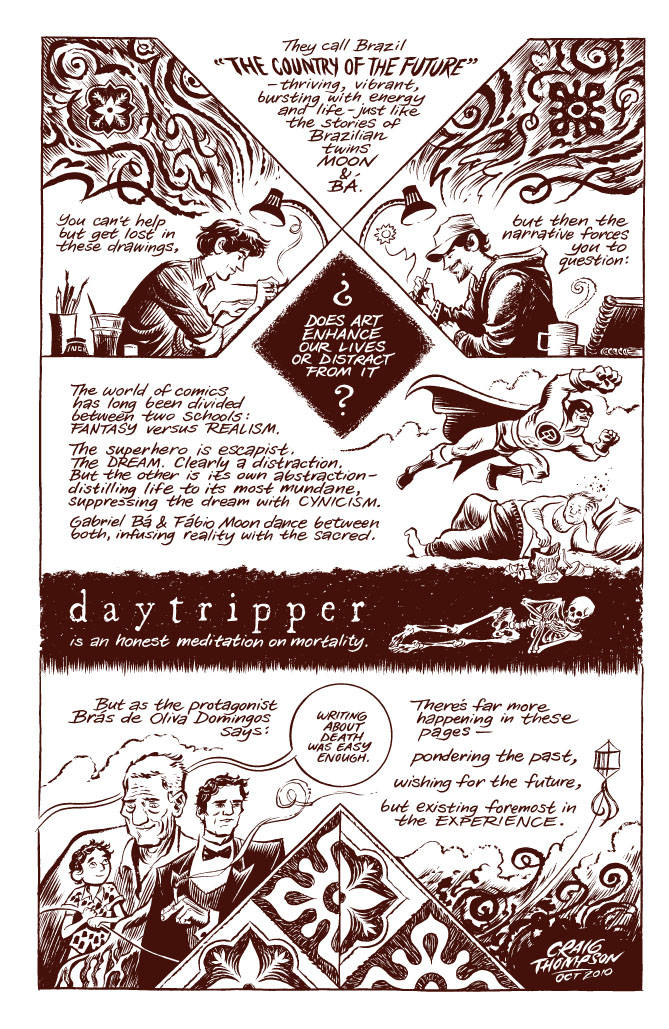

How do you measure a human life? Is it by weighing your list of accomplishments or recognizing major events as well as the moments that may seem insignificant? Perhaps it is all of these things and as we can see in Fabio Moon and Gabriel Ba’s Daytripper – a graphic novel that celebrates life’s big moments as well as the little moments that are just as important but also recognizes death as a part of life.

Daytripper introduces us to Bras de Oliva Domingos, son of a famous Brazilian writer and something of a writer himself since he pens some genuinely touching obituaries for the local newspaper in Brazil. Called the “Little Miracle” by his mother due to an event that took place during his birth, Bras finds himself thinking of ones mortality. On the evening he was attend a gala in his father’s honor, a stop to a nearby bar results in Bras’ death by the hands of an armed thief.

Yet this is not the end of the story for Bras’ life is filled with life’s little and big moments that keep including death. We find Bras in his twenties as he and his closest friend, Jorge, take a little trip to the beautiful city of Salvador where he meets a gorgeous and voluptuous woman named Olinda who he instantly attracted to and spends a memorable night with in this beach-side paradise. It is that same Olinda that a few years later breaks his heart by storming out of his place. A year later, however, Bras finds love again while getting his morning coffee … and finds death again crossing the street after deciding to go back and talk to the beautiful woman that caught his eye.

Life takes another turn for Bras as he and the same woman he met in the cafĂ© is expecting their first child only for Bras to miss out on his son’s birth returning home to get something his wife requested. Unfortunately, the day of his son’s birth is also brings with it the death of Bras’ father. The young man looks back on his childhood as the family often took trips to their kin’s cottage when Bras’ father would use as the perfect opportunity to write. It is in one of those trips that young Bras experienced his first kiss under the winding roots of a tree with a pretty half-cousin.

Then there’s a defining moment in Bras’ career with a commercial airliner crashes at takeoff and pushes the man to write several obituaries for each confirmed passenger from the flight. Not only is it beautiful stuff but it inspires him to write his first novel that becomes a success. At last, Bras feels like he has caught up with his father. Unfortunately, the book tour takes him far from his wife and son who miss him very much. On top of that, his best friend disappears only to be discovered in a rundown shack in a bad mental state.

We finally reach the end of Bras’ life as a gray-haired Bras returns home after getting bad news from his physician. Bras isn’t afraid of what awaits him … he never was in the many death we see through his eyes. The fact is simple: one experiences life and takes in all the things it has to offer. There are good moments in our lives and bad ones but they are a part of the big picture that makes up our existence.

Fabio Moon and Gabriel Ba paints this big picture called life in a way that you can feel what Bras goes through and relate to his ups and downs as well as the emotions that come with it. It’s a powerful thing for a graphic novel to make you feel and Daytripper does it so effortlessly. The art is also considerably impressive and just as expressive as the writing itself. Even Dave Stewart’s coloring is perfect enough that it compliments every panel to make this a beautiful-looking graphic novel.

Daytripper is as big and as meaningful as the story of Bras’ life and it will not fail to make us think and feel and wonder, which is a rarity within itself. With magnificent storytelling and artwork that is equally stellar, this graphic novel is easily one of this year’s best graphic novels and one that should be on anyone’s list regardless of your favorite genre. This is storytelling at its more perfect and I cannot recommend this one enough.

Click to read more.

Cross Game graphic novel vol. 1 by Mitsuru Adachi

Dennis Amith
nt2099.com


Mitsuru Adachi is one of the most highly respected mangaka in Japan.

He is also known for his manga that revolves around baseball and high school/grade school crushes. But Adachi’s most famous work is “Touch”, a baseball/romantic comedy and a winner of the 1983 Shogakukan Manga Award (his second consecutive award a year after his highly successful high school romantic comedy manga “Miyuki”).

The manga series for “Touch” was award-winning, the anime series is one of the highest-rated television anime series of all time and it was a story that literally made audiences cry as it featured a story of friendship, tragedy, loss, inspiration and hope.

Adachi would go on to feature other stories that revolved around other sports but one wondered if he would return to baseball (which is a very popular sport in Japan) and in 1992, Adachi would write a baseball-related manga series titled “H2″.

Over 13 years later, fans continued to clamor for another baseball-themed anime series and Adachi would return with the manga series “Cross Game”, similar to “Touch” would feature a romantic comedy that would feature friendship, tragedy, loss, inspiration and hope.

And with Adachi’s first baseball manga series “Nine” along with “Touch”, “H3″ and “Cross Game”, the goal of the baseball players and characters are to make it to “Koshien” which translates to “tournament” and in Japan there are the “National High School Baseball Invitational Tournament” held in the Spring and “National High School Baseball Championship” in the Summer.

In Japan, the final 17th volume of the manga series was released in Japan and now, “Cross Game” will be released in the US in graphic novel format (compiling several of volumes into one release). “Cross Game Graphic Novel Vol. 1″ compiles the first three manga volumes into one collection.

“Cross Game” is a manga series that showcases the development of a Ko Kitamura, the son of a family that owns Kitamura Sports, during the time he is a 5th grader, a junior high school student preparing for high school and then later on in high school.

Click to read more.

Sunday, March 27, 2011

Milking chickens, man of bronze and writing tips

Here's the first page of the next scene, All in. I forewarned that you'll see left hands where they don't belong - and on this page the terror returns.

Disregard the man with the two left hands - he ate the wrong thing for breakfast and now he's ... got awful left hands. For the record, if you're drawing someone holding a phone, the fingers should always be facing the front of the speaker's head, and the thumb is to the back of the phone - unless you're drawing it wrong. The thumb is very rarely going to stick out at the front.

For the record, I'm reading "The English Patient" and the character Caravaggio has no thumbs, because they were cut off in the war. The only reason he wasn't murdered by the Axis is because the Allies were approaching, so they had to stop punishing Caravaggio. Just so you know.

Graphic novel news

How to Write a Graphic Novel Story Template
Spanner Spencer

eHow.com


A graphic novel is a narrative work that uses sequential art to deliver the story to the reader, much like an extended, feature-length comic book. The storytelling techniques employed in writing the script for a graphic novel are the same as any work of fiction, requiring careful attention to the story's structure, theme, characters and narrative. By gradually building an outline template, the story's development time can be significantly reduced. This is achieved by starting with the story's core concept as the foundation, and expanding it incrementally until it's ready for the first full draft to be written.

Instructions

* 1 Write a "tag line" for your graphic novel, which conveys the story's concept in a single short sentence.

* 2 Expand the tag line into a "log line" by writing a sentence explaining the story's beginning, two sentences for the middle, and another single sentence for the ending.

* 3 Write a synopsis of the graphic novel by expanding each sentence in the log line into a full paragraph. The finished synopsis still shouldn't be longer than a single sheet of paper.

* 4 Take each paragraph in the synopsis and expand it to a fill a full sheet of paper, but no more. This is the first stage of your graphic novel's outline.

* 5 Proofread the outline thoroughly, and go back through each stage of the template, making any necessary adjustments to the story. Begin with the tag line and work forward from there until you have a second draft of the four page outline.

* 6 Write biographies for each of the characters that were important enough to warrant a mention in the outline. Include details of their childhood, their physical appearance, family history, what they do for a living, how they spend their free time and what their motivation is within the graphic novel's story. The biography should cover their lives up until the point at which the graphic novel's story begins.

* 7 Rewrite the outline based on any changes that have surfaced after writing the character biographies, and expand each page as much as you like into a "step outline." This step outline should cover everything that happens within the entire story, but without including any dialogue. Keep going back over the whole template, making adjustments as the story and characters evolve within the step outline.

* 8 Write the first draft of the graphic novel's script, following the step outline closely.
Click to read more.

Graphic novel anyone?
joanbettystuchner.blogspot.com


It's taken a while but I've started to think seriously about the graphic novel. Writing one, I mean. Certainly not illustrating one. I am not an artist, which is the understatement of the year. I'm probably going to sign up to attend the Vancouver Children's Literature Roundtable Graphic Novel Event at the end of February, in order to learn more about this genre. I've attended a couple of talks, but this is an all day intensive so I'm hoping for inspiration. If any of you have the good fortune to possess both writing and illustrating talents you're a step ahead, but I think the key to a good graphic novel is combining the writing and the graphics like a recipe with measured ingredients. Now usually when I write the text of a picture book I have almost no power over the illustrations - though the publisher usually keeps me in the loop. That's as it should be. I often don't get to meet the artist, who might even live in another province. But I suspect that with a graphic novel the writer and artist have to work together as a tight-knit team.

So I keep thinking about the story of mine that publishers always love, but don't want to touch, because they can't figure out who to market it to (neither can I, only how about 'anyone of any age that actually finds it funny?') I know that it would work as a graphic novel. I feel it in my bones - unless that's just the osteo-arthritis acting up - but there's a problem. The language of that story is so important. Not to hold myself on the same level of greatness as Oscar Wilde, but it would be like creating a graphic novel from 'The Importance of Being Ernest.' I could, however, see two versions. The witty, wordy version and the graphic version. I'm talking about my story and Wilde's play, by the way.

What do you think? Maybe get together with an artist friend and see if you can come up with a graphic novel or short story (read Irene Watts' graphic version of her novel 'Goodbye Marianne.' Then read the novel. Check the differences). I think it would be very creative if your school combined an art class and an English/creative writing class and teamed up kids to create graphic novels.

I'll get back to you with more on the subject after February. Meanwhile, keep on writing.
Click to read more.

J.G. Jones: Man of Bronze
by Jeffrey Renaud

Comicbookresources.com


Superman, Batman, Reed Richards, Indiana Jones, James Bond and even Buckaroo Banzai -- these and many other pop culture icons were inspired at least in part by Doc Savage. But beyond creations on the printed page, silver screen and more, the Man of Bronze motivated a generation of creators, as well. One of those creators, J.G. Jones, is about to fulfill a fantasy he's held since he was a young boy growing up in Walker, Louisiana.

But the superstar artist known for his Eisner-nominated work on "Wanted" and "Final Crisis" won't be drawing the title for DC Comics, he's writing it beginning with "Doc Savage" #13, which is scheduled to be released April 13.

A self-described fan of the character, Jones will be continue delivering covers for "Doc Savage" for the duration of his six-issue run as writer while Qing Ping Mui ("Warcraft Legends") will serve as the interior artist.

Jones told CBR News how his collaboration with Ian Sattler, DC Comics' Director–Editorial, Special Projects & Archival Editions, on a forthcoming original graphic novel led to him writing the series. He also teased about what Doc and the Fabulous Five will be up against in his arc "Raise the Khan," which best-selling title he'll soon be providing covers for and also a little about what historical event moved him enough to create the aforementioned OGN, "Dust to Dust."
Click to read more.

Friday, February 25, 2011

Here is page 31 for Tomb of the Undead from the scene Stealing Hope. This ends the scene, albeit the course of action continues in at the same location, immediately following what happens right here.


I’m making a graphic novel, any tips?


Question by SoenKen2145: I’m making a graphic novel, any tips?
Ok I am recentily making a graphic novel. Is it good to write the script of it then draw the chapter, or write the entire script for the whole comic instead on indivedual chapters? Also what comic in your opinion would stand out?(like your favorite cover art) Also what are good tips to make my novel stand out above the others? Also can you sell your novel copys to books stores? Would you buy a comic created by a amatur artist(not perfect art, but ok) but it had great storyline? Also any other good tips you can think of for publishing and selling your book?
Best answer:
Answer by leyliz
i mean this is the nicest possible way…but maybe you should take reading and writing classes to brush up on your grammar and spelling…


Everything Guide to Writing Graphic Novels: From superheroes to mangaall you need to start creating your own graphic works (Everything: Language and Literature)


Watchmen. V for Vendetta. A History of Violence. The Sandman. 300. You've read them, you've loved them, and now you want to write and illustrate them. The Everything Guide to Writing Graphic Novels is your shot at the big time. Whether you want to go as dark as Sin City, as funny as Bone, or as poignant as Maus, this book shows you how to do it all. You'll learn how to: Develop memorable characters Create intricate storylines Illustrate, lay out, and design panels that pop Letter your dialogue Market and promote your work It's all here for you. Professional graphic novelists Mark Ellis and Melissa Martin Ellis show you the ropes of the industry and how to make your graphic novel matter. They help you to take the ideas out of your head and put them onto the page. Lavishly illustrated with more than 100 drawings, this guide also features full-color examples of Mark Ellis's distinctive graphic style. Dramatic? Humorous? Off-beat? With pen in hand, it's up to you.
Buy the book?

Dan Smith Hacks Up The Samurai
Read below and learn about Dan's process behind his story for Samurai The Graphic Novel.


In two sentences what is your STGN about?
How everyone influences everyone, no matter if it is positive or negative. What you say and do will have consequences.

Where did your STGN story come from? What were your trying to achieve with the art?
The classic samurai movies were my main impetus for doing "An Honorable Death". Throne of Blood/Kwaidan for the ghost aspect and Harikiri for the winter setting. The art style was trying to incorporate a slightly anime feel to my normal cartoon style...


What was your experience like working on Samurai The Graphic Novel. Was it a challenge?
It was a challenge. My initial story was 32 pages, and 1/4 of the way through it had to be pared down to 24 pages due to space restrictions...which was good, because it tightened the story into what I believe to be a better read. Second, my collaborators were coming up with such great concepts and art, it forced me to get my A game on...in the end, I am pleased with my results. (Never satisfied, but pleased. ;).)

What was your process for creating your story for STGN? Describe it step by step.
I work in a strange "artist" way (of which I am in the process of NOT doing...) of :
1. Concept-plot and script ideas
2. Layout- breakdowns of the pages
3. Story-text
4. Art-pencil/ink/color
5. Word balloons and final text.

In one word what best describes your style?
Conflicting.

How many years have you been creating art?
36 years.

What's your biggest influence artistically/story wise?
No one specifically, although in the future I will probably "use" someone in particular to keep my course more consistant.

Why do you think the idea and iconography of the Samurai resonate with the imagination?
Samurai tales are like western tales as they speak of personal moral issues. And they are visually powerful!